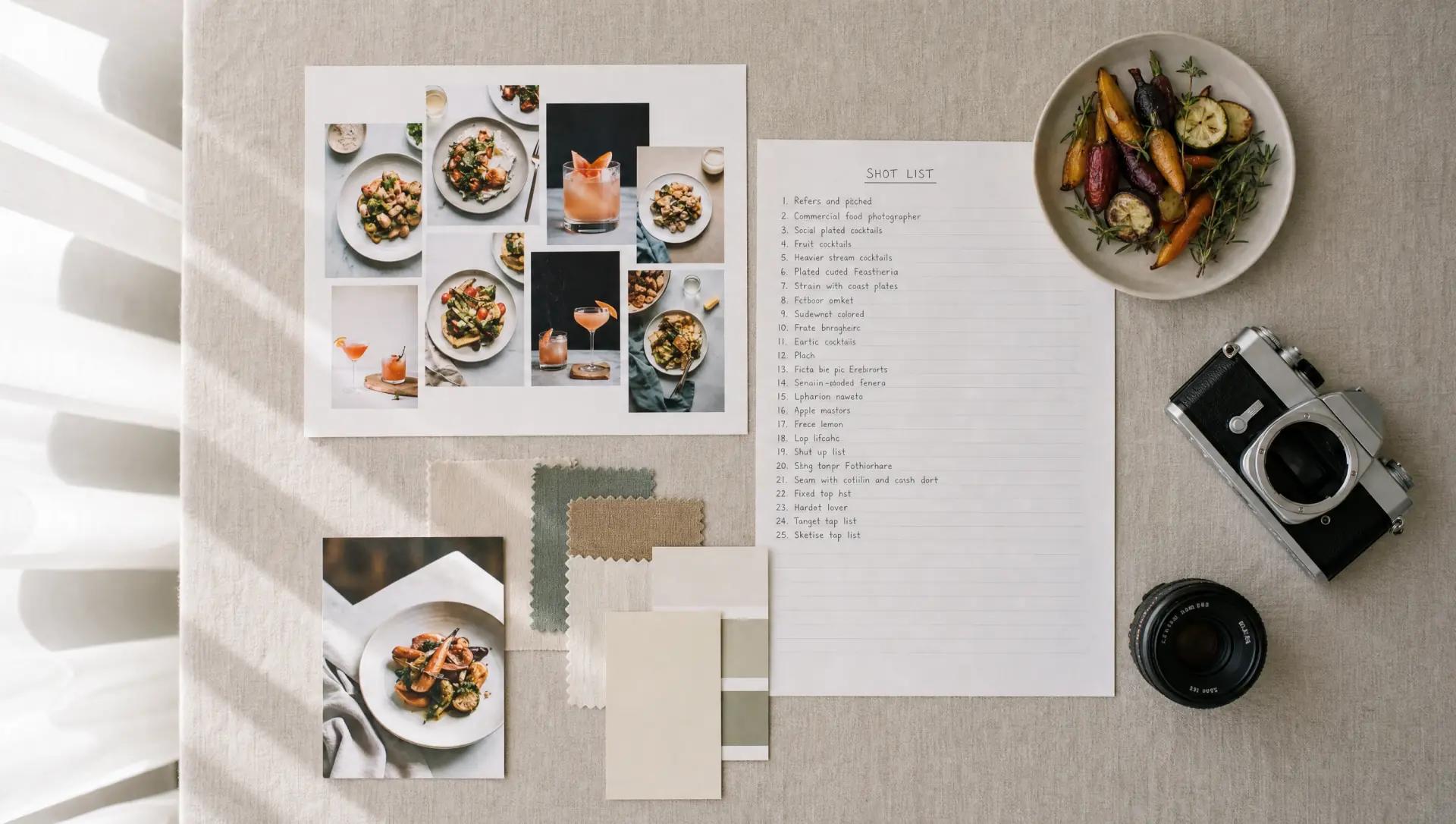
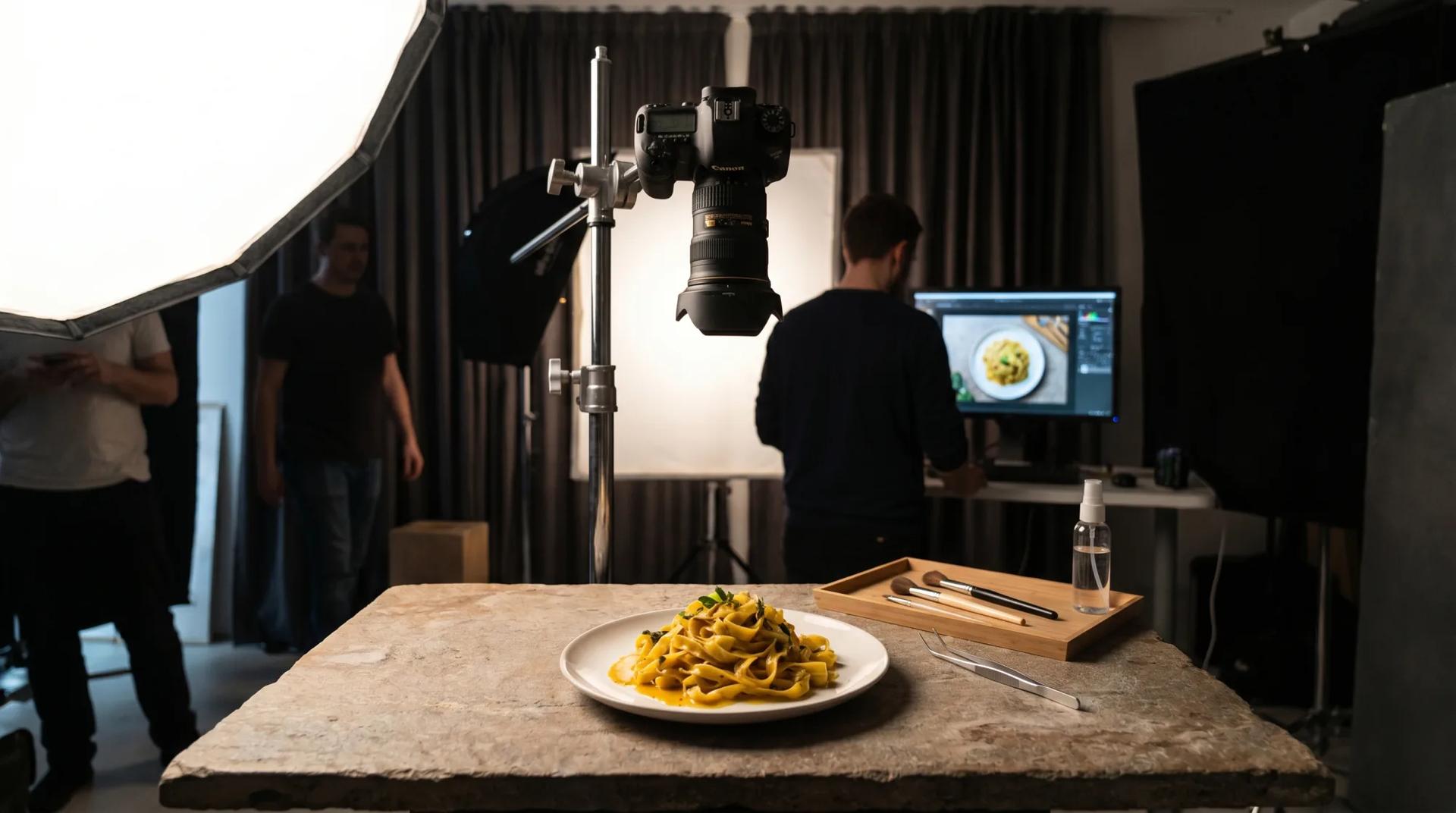
TL;DR: A shot list for food photography that names subjects is not a production plan. The brands that get the most from a shoot day build their list backward from desired outputs: the channels each frame needs to run on, the format ratios those channels require, the negative space built in for headline overlays, and the motion moments flagged before the food arrives on set. This post walks through how that works.
Shot List vs. Asset Brief in Food Photography
Most clients arrive on shoot day with a subject list: "burger, overhead, clean; cocktail, 45 degrees; chef at the pass." That names what to point the camera at. It does not say what those frames need to produce.
An asset brief inverts that. It starts from the output: which channels is this image running on, what crop ratios do those channels require, does this frame need a clean area for a headline overlay, does this setup have a motion moment worth capturing. Work backward from those answers and the shot list writes itself.
The difference is between producing deliverables and building a library. Adobe/Advanis (2025) found that 78% of organizations produce over 1,000 brand assets per year, yet 48% of marketers say they are already struggling to keep up with demand. The production volume problem is not solved by scheduling more shoots. It is solved by getting more from each one.
"Burger, overhead, clean" is not a production shot list. It is a wish.

The Four Output Layers
A well-planned setup on a food shoot has more than one frame in it. The question is whether those frames were planned or left on the table.
The model that maps to how commercial food shoots actually run breaks down to four output layers. Hero frames are campaign-ready images: the primary brand expression, the frame the client leads with, the one that earns the most of the shoot day. Supporting angles are the product detail, the texture, the process step, the secondary storytelling that fills supporting channel positions. Negative space is not an aesthetic preference; it is a functional requirement. A paid media image that needs a headline overlay has to be framed with room for the text. That decision is made at the shot list stage or not at all. Motion potential covers which setups contain a pour, a steam rise, a garnish drop, or a drip that can be captured as a loop or short-form clip.
Every frame is different, and every dish is different. On a restaurant shoot, understanding which dishes are the stronger sellers shapes how much attention and prep time each setup gets. An advertising moment that needs clean open space for text placement needs different framing than a supporting side dish being shot for social.
Plan four outputs from each setup and a shoot day yields a library. Leave them implicit and it yields a folder of similar-looking subjects.
Framing for Every Format Before the Shoot
A brand running paid media across five major platforms needs content in at least six distinct aspect ratios. Ignite Social Media's 2025 platform guide confirms that Meta alone requires three ratios to cover all feed and stories placements. Every ratio missing from the shot list is a ratio that cannot be served to the algorithm later without a reshoot.
One well-lit setup can yield a 16:9 hero, a 1:1 for feed, a 4:5 for paid, and a 9:16 for stories, if the photographer framed it that way. If not, every cropped version is a compromise and the tightest version dictates what all the others look like.
The capture decision happens on set. The format question is answered at the planning stage. This is part of what briefing a photographer well before the shoot actually means: naming the channels, the ratios, and the use context for each setup alongside the dish list. That information changes how the photographer frames every shot.

Planning Motion at the Shot List Stage
Motion is the output layer most commonly treated as an afterthought: a decision made on the day when the setup is already lit, the food is already styled, and the crew is already watching the clock.
Planning a motion moment starts with recognizing it during pre-production, not on set. A pour, a steam, something with natural movement. Once that moment is identified, the questions that follow are practical: how does this pour, how does this serve, does the movement actually behave the way the clip needs it to? Those questions change the food prep, the number of duplicate dishes needed to get a clean take, and sometimes the surface or lens choice.
Motion capture requires a prepared setup. A motion moment absent from the list before the food is ordered rarely gets captured well on the day.
Sequencing a Hospitality Shoot
A hospitality shoot adds complexity that a single-product setup does not have. Architecture, service moments, food heroes, team portraiture, and brand detail all need capturing, and several of them carry hard timing constraints tied to the kitchen's rhythm.
Architecture always goes first. It does not depend on the kitchen, the food is not on the pass yet, and the space can be controlled before operational prep turns the room into a working environment. Food heroes come at the lull points in prep and service, when the kitchen can focus and execute properly instead of rushing. Portraits slide in anywhere during the day. Service moments require a full restaurant: real guests, real atmosphere, the client present to see it happen.
Getting the sequence wrong means asking a kitchen to hold a dish while a portrait runs long, or missing the service moment because architecture ran over. Each category of capture on the shot list should name what to get, when that becomes possible, and what it depends on.
The real cost of a missed or incomplete shoot day lands in post-production and in the absence of content when the campaign window opens. Both are preventable with a shot list that treats sequencing as a production decision, not an afterthought.
Build the Plan Before You Pack the Car
Brent Herrig Creative is a culinary motion production company based in New York and London. The brands that leave a shoot day with a library rather than a folder of subjects did not get there by shooting faster. They arrived with a plan built backward from outputs, formats, and motion, not just subjects.
A shot list that specifies four output layers per setup, maps each frame to the format ratios its channels require, and flags motion moments before the food arrives is not more work at the planning stage. It is less work after it. And it is what makes a single well-structured shoot day extend across platforms and into a global production workflow without rebuilding the asset library from scratch for every campaign.
If you want to go through your brief and shot list before the next shoot, book a call and we can map it together.
Frequently Asked Questions
What is the difference between a shot list and an asset brief in food photography?
A shot list names the subjects. An asset brief defines the required outputs: channels, format ratios, use context, and motion moments. Working backward from outputs means the photographer frames each setup to deliver what the campaign actually needs. Most clients arrive with a subject list. The shot list that produces a reusable library starts from what the assets have to do, not just what they need to show.
How do you plan for multiple aspect ratios in a single food photography setup?
The planning happens before the shoot, not in post-production. Each setup on the shot list should specify which channels it serves and what crop ratios those channels require. A setup that needs to deliver 9:16 and 16:9 from the same lighting state is a different framing decision from one that only needs a square crop. Decide this at the brief stage and the photographer can frame for it on the day.
How do you plan a motion moment at the shot list stage?
Identify the setup with natural movement during pre-production, not on set. Then answer the practical questions before the food is prepared: how does the movement behave, how many duplicate dishes will multiple takes require, and what does the surface or lighting need to support the clip? Motion capture requires a prepared setup. Motion moments left unplanned before the food is ordered rarely get captured well when the day runs at pace.
How should a hospitality shoot be sequenced across architecture, food, and service moments?
Architecture first, before the kitchen starts prep and before operational pace changes the space. Food heroes at the lull points in prep and service, when the kitchen can focus. Portraits anywhere during the day. Service moments when the restaurant is actually full and the client is present. Getting the sequence wrong means holding food unnecessarily or missing the service moment because other captures ran long.