TL;DR: A commercial food shoot is not one fee. It's a stack of line items: creative and shoot fees, food styling, ingredients and props, studio or location, crew, post-production, and usage rights. Established independent commercial photographers typically run $1,800 to $8,500 per day before those other lines are added. The two costs clients underestimate most are licensing and retouching. When you understand the full stack early, the budget conversation stops being a wall and starts being a plan.
When a brand asks "what does a food shoot cost," the honest answer is another question: what do you need the images to do? A single hero shot for a menu and a multi-platform campaign that runs for two years are both "a food shoot," and they are not in the same budget universe. The number isn't hiding. It's built from parts, and once you can see the parts, you can plan around them.
I've watched the budget conversation go two very different ways. When a client comes in with no sense of what drives cost, the conversation tends to collapse into "that's too expensive" before we've even talked about what they actually want. When a client understands the components, something better happens. We start solving. "We can't afford the full campaign" turns into "we can shoot the hero assets now, build the variation library next quarter, and structure the licensing so it grows with the rollout." Same budget. Completely different outcome. The difference is almost always whether the client can see the line items.
This post breaks down those line items so you can plan with confidence. The ranges here are drawn from published industry rates and checked against how these projects actually price out in practice. They are not my rate card, and they aren't a quote. They're a map of where the money goes and why. To see what these line items produce on finished work, browse the commercial food photography portfolio.
What Actually Goes Into a Commercial Food Shoot Budget?
A commercial food shoot budget is a system of related costs, not a single creative fee. The main components are the creative and shoot fee, food styling, ingredients and props, studio or location, crew, post-production, and usage rights. Each one scales with the ambition and reach of the project.
Think of it the way you'd think about producing anything physical. The headline number is the thing people quote, but the headline number sits on top of materials, labor, space, and the right to actually use what you made. Skip a layer and the project doesn't get cheaper. It just gets fragile.
The Creative and Shoot Fee
This covers the photographer's time, skill, planning, and direction on the day. It's the line most people picture when they imagine "the cost of the photographer." For established independent commercial photographers, day rates commonly fall in the range of $1,800 to $8,500 per day (not including usage rights), with newer shooters lower and high-demand specialists higher.
What that fee buys is not just the hours behind the camera. It's the judgment that decides which angle sells the dish, which light makes the sauce look like something you want to eat, and which fifty frames out of five hundred are actually worth delivering. The shoot fee is where craft lives.
Food Styling, Ingredients, and Props
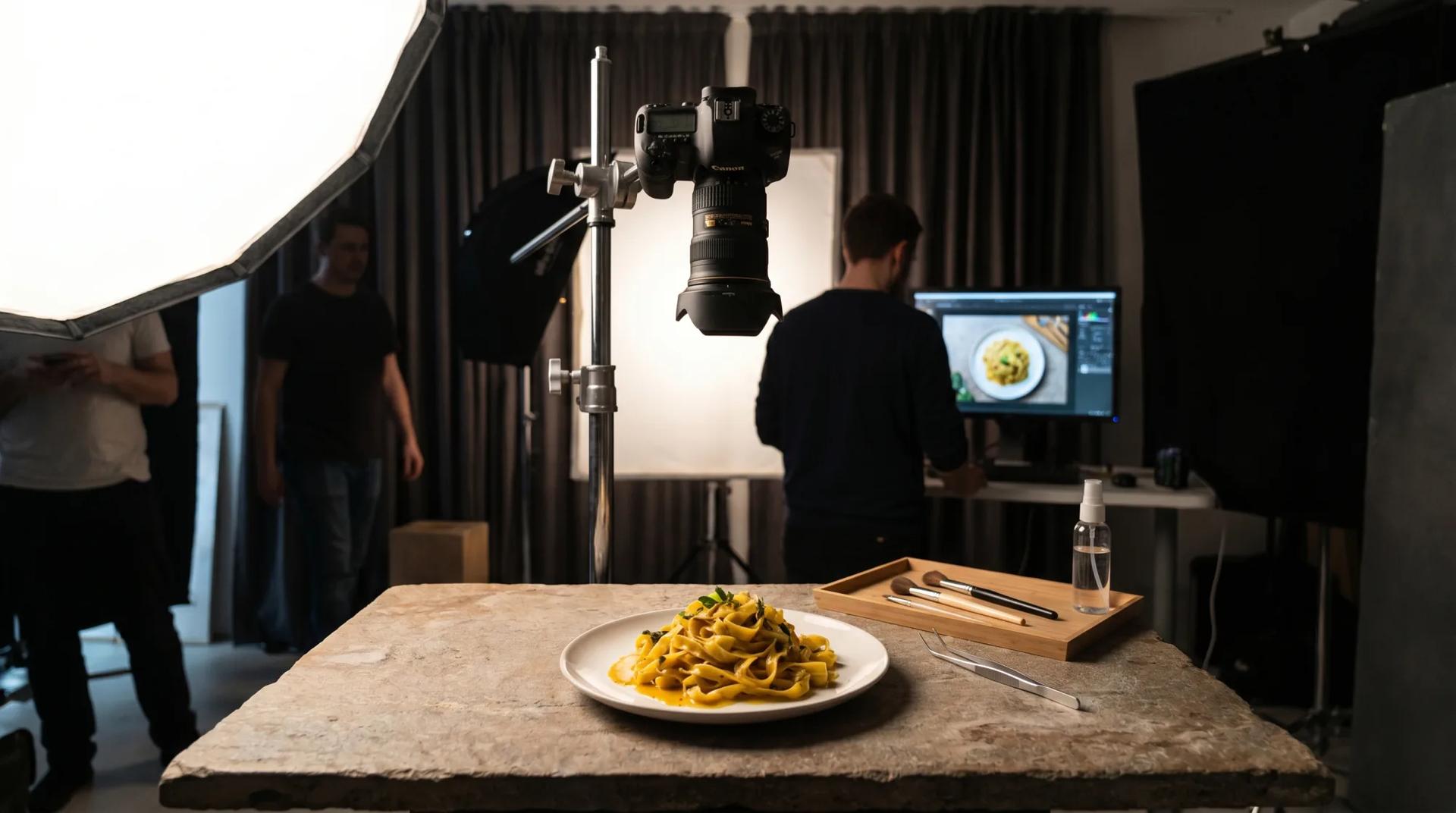
Food styling is its own profession, and on a serious shoot it's not optional. A good stylist is the difference between food that looks edible and food that looks irresistible. Commercial food stylist day rates generally run $1000 to $2,500 or more per day, and stylists frequently bill prep days separately from shoot days because the prep is real work that happens before anyone turns on a light. And many stylists work with a food and prop assistant. A good prop assistant is worth their weight in gold.
Then there's the food itself. You don't buy one of the dish you're shooting. You buy enough to build several "hero" plates, because the perfect one rarely survives the first take, and you often need backups as ingredients wilt, melt, or dry under lights. Add props, surfaces, backgrounds, and linens, and you have a materials budget that's easy to underestimate if you've never produced a shoot before.
Studio or Location
Where you shoot is a real line item. A rented studio day, a restaurant you're shooting in during off hours, or a location with the right natural light all carry cost, whether that's a rental fee, a buyout of the space, or the logistics of shooting around an operating business. Natural-light locations can look "free" until you account for the time and crew needed to control conditions you don't own.
Crew
Beyond the photographer and stylist, a commercial shoot often needs assistants, a digital tech to manage capture and color, and sometimes a producer to keep the day on schedule. Assistant day rates commonly start around $400-750 per day. A Digital Tech can cost anywhere from $600 to $2,500 per day depending on the job and their experience. Crew scales with complexity. A simple tabletop setup needs less. A multi-setup campaign day with motion and a dozen dishes needs more hands to stay on time.
| Creative & photography fee1 shoot day | $6,500 |
| Food styling1 prep day + 1 shoot day, plus assistant | $4,500 |
| Food, props, surfaceshero plates, backups, linens | $1,800 |
| Studio rental1 day | $1,500 |
| First assistant1 day | $650 |
| Digital tech1 day, capture + color | $1,200 |
| Post & retouching12 hero images, multiple crops | $3,600 |
| Usage / licensing1 year, US digital | $5,000 |
| Estimated total | $24,750 |
A breakdown like the one above is the single most useful thing a client can see early. Once the costs are visible as parts, the conversation stops being a yes or no on one big number and becomes a set of decisions you can actually steer.
The Two Costs Clients Underestimate Most
In my experience, two line items surprise clients more than any others: usage rights and post-production. Both are easy to overlook because neither happens on the visible "shoot day," and both can quietly become the largest numbers in the budget.
Usage Rights Are a Cost, Not a Formality
Here's the part that catches people off guard. Paying for the shoot does not mean you own the images forever, across every channel. Under U.S. copyright law, the photographer holds copyright at the moment of capture, and what the client receives is a license defined by where the images run, for how long, and in which markets. The broader the usage, the higher this line.
This matters for your budget because the same photo has different commercial value depending on use. A shot living on your own website is one thing. That same shot on national paid media or packaging is another. Usage isn't a penalty bolted onto the invoice. It's how the price matches the actual business value the images deliver, and it's often the difference between two quotes that otherwise look identical.
Because this is the single most misunderstood cost in commercial food photography, it's worth understanding on its own terms. I wrote a full breakdown of how licensing works, what "buyout" actually means, and how to scope it fairly in this guide to usage rights for commercial food photography. If you take one thing into your next budget conversation, make it this: bring your media plan, so usage can be scoped accurately from the start.
Post-Production Is Where Hours Hide
Retouching is the other quiet cost. The shoot captures the raw material. Post is where it becomes a finished, on-brand, channel-ready asset. High-end commercial and advertising retouching commonly runs $50 to $1000's or more per image, and specialist retouchers bill roughly $125 to $250+ per hour for advertising-level work. (Note: this can vary wildly based on complexity and scope of work.) This may seem expensive, but consider that high-end food retouching may require days or even weeks of skilled labor, especially if multiple takes or angles need to be composited together.
The number that surprises people is total volume, not per-image cost. A campaign isn't ten finished images. It's ten hero images plus the crops, the negative-space versions for text overlay, the platform-specific aspect ratios, and the seasonal variations. Every one of those is post-production time. If your brief asks for "a few photos" but your media plan needs forty deliverables in six formats, the post budget is going to be much larger than the shoot fee, and that's normal. It's worth planning for, not discovering later.
Why a Bigger Budget Conversation Leads to Better Work
The most useful thing a client can do is talk about budget honestly and early. Not because the number gates the creativity, but because it shapes it. When I know the real constraints up front, I can design the production around them instead of pretending they don't exist.
This is the shift I mentioned at the top, and it's worth being concrete about. A vague brief with a hidden budget forces everyone to guess, and guesses run high to cover risk. An honest budget, even a tight one, lets us get creative about how to deliver. Maybe we shoot a focused set of versatile hero frames instead of a sprawling shot list. Maybe we capture supporting angles and negative space on the same day so the assets stretch further across channels. Maybe we phase the work so the rollout funds the next round. None of that is possible when the budget is a secret.
A shoot is creative infrastructure, not a one-time expense. The frames you capture today should feed your website, your paid social, your menus, and your campaigns for months. When you budget for the full system, including the styling, the post, and the usage, you're not paying more. You're paying for assets that actually do the job instead of a cheaper set that falls apart the moment you try to scale them.
How to Plan a Realistic Food Shoot Budget
You don't need to be a producer to walk into the conversation prepared. A few inputs change everything about how accurately a shoot can be quoted and how creatively it can be solved.
Start With Deliverables and Usage, Not a Day Count
Don't start with "how many days." Start with what you need the images to do. How many final assets, in which formats, running on which channels, for how long. That set of answers drives the shot list, the styling load, the post hours, and the licensing all at once. Get those right and the day count falls out of them naturally. Then you can discuss the timeline, how many days are required to produce the required assets, and any other details that will help you arrive at your final budget.
Budget the Whole Stack, Then Phase It
List every layer: shoot fee, styling, food and props, studio or location, crew, post, and usage. Total it honestly. If the full number is more than this round can carry, phase it rather than gut it. Shoot the highest-value assets first, build the variation library next, and structure usage so it can expand as the work rolls out. A phased plan keeps the quality intact. A slashed plan usually doesn't.
Bring Your Real Budget to the First Call
The fastest way to a creative solution is an honest constraint. When you say the real number, a good production partner can tell you what's achievable, what to prioritize, and where to get the most reuse per dollar. The conversation stops being "yes or no" and becomes "here's how."
Frequently Asked Questions
How much does a commercial food photography shoot cost?
There's no single number, because a shoot is a stack of costs: creative and shoot fee, food styling, ingredients and props, studio or location, crew, post-production, and usage rights. Established independent commercial photographers can charge anywhere from a few thousand dollars to upwards of $100,000+ depending on the scope and reach of the project. So bring your budget to the table and let's talk about what's possible.
Why is food styling a separate cost from photography?
Food styling is a distinct profession focused on making dishes look their best on camera, and it carries its own day rate, commonly $1000 to $2,500 or more per day. Stylists also often bill prep days separately, plus the cost of ingredients, backups, and props. On a serious commercial shoot, styling is what separates food that looks edible from food that sells.
Why do usage rights affect the price of a food shoot?
Because paying for a shoot buys a license, not outright ownership, and the price of that license scales with use. The same image is worth more on national paid media than on your own website, so broader channels, longer terms, and bigger markets increase the cost. Scoping usage accurately at the briefing stage keeps the budget predictable. See our full breakdown of usage rights for commercial food photography.
How much should I budget for retouching and post-production?
More than most people expect, because cost scales with deliverable volume, not just per-image complexity. High-end commercial retouching runs from $50 per image to $1,000's per image, and a campaign usually needs each hero image in multiple crops, formats, and variations. Plan post around your full deliverable list, not the number of dishes shot. Remember you get what you pay for when it comes to post-production.
Will sharing my real budget get me a worse deal?
Usually the opposite. An honest budget lets a production partner design the shoot around your real constraints, prioritize the highest-value assets, and find creative ways to get more reuse per dollar. Hidden budgets force everyone to guess, and guesses run high to cover risk.
Building a Budget That Holds Up
The real cost of a commercial food shoot isn't a mystery, and it isn't a single number. It's a system of line items, each tied to what you need the images to do. When you can see the whole stack, the conversation changes from "can we afford this" to "how do we build this well," and that's a far better place to start.
The clients who get the most from a shoot are the ones who plan for the full system and talk about budget early. That clarity is what lets a production partner get creative on your behalf instead of guessing in the dark.
If you're planning a food or beverage shoot and want to map the real budget before committing, book a call and we can walk through the line items, the priorities, and the smartest way to phase the work for your goals.