TL;DR: A unified brand identity is not a logo file and a color palette. It is a system of visual and verbal decisions that repeat consistently across every touchpoint. The strongest brands treat their photography, design, and voice as infrastructure, not decoration. When the source assets are right, consistency becomes the default instead of the exception. Research from the IPA found that higher creative consistency correlates with stronger brand and business effects across 56 brands and 4,000 ads.
Most brands do not have a consistency problem. They have a source problem.
The symptoms look like inconsistency: the website feels premium, the menus look dated, the social grid drifts in a different direction every month, and the in-venue signage belongs to a brand that no longer exists. But the cause usually sits further upstream. The photography was never planned for reuse. The voice was never written down. There was no agreement about what stays fixed and what is allowed to move. So every team improvises, and improvisation compounds.
This post lays out a practical model for fixing that. Not a mood board, and not a 60-page brand bible no one opens. A working system: three layers, a way to spot where it breaks, and an audit you can run this quarter.
Why Consistency Is the Mechanism, Not the Goal
Consistency is not the point. It is how the point gets across.
When an audience sees the same colors, the same imagery style, and the same voice across enough touchpoints, they stop reading your brand as separate pieces and start reading it as one thing. That is the entire job. Repetition turns brand cues into learned meaning. A color becomes shorthand. A photographic style becomes recognizable in a thumbnail. A turn of phrase starts to sound like you and only you. This is semiotics doing quiet work in the background: a signifier, repeated, becomes a signified.
The business case for this is well documented. The Institute of Practitioners in Advertising summarized a cross-channel study called Compound Creativity, built on more than 4,000 ads from 56 brands over five years, and reported that higher creative consistency was associated with stronger brand effects and stronger business effects (IPA, 2024). On the perception side, Lucidpress and Marq's State of Brand Consistency snapshot of 450 respondents found that organizations projected revenue uplift in the range of 10 to 20 percent when brand consistency improved (Marq, 2021). Treat the revenue figure as directional rather than causal, but the direction is not in dispute.
Here is the nuance most articles skip. Consistency does not mean uniformity. The strongest results come from consistent brand codes and positioning while the creative execution evolves by channel and context. You protect the meaning. You let the format move.
The Three Layers of a Unified Identity
A unified identity is easier to manage when you stop treating it as one big thing and start treating it as three layers that each have an owner.
Visual System (What People See)
This is the layer everyone thinks of first: logo, color, typography, imagery style, motion principles. It is also the layer where most brands quietly skip the most important part.
The part that gets skipped is source photography quality and planning. Logos and color palettes are easy to govern because they are fixed files. Imagery is not. Every campaign, every season, every new dish or room or product generates new images, and if those images are not planned at the shoot level, every downstream use becomes a workaround. The website crops awkwardly because no one shot for negative space. The vertical social format does not exist because the shoot was framed for landscape. The paid team pulls a frame that was never meant to carry text.
Classic identity systems understood this. The NASA graphics standards manual treated the brand as an engineered communications system, not a style preference, and stressed that consistency had to be enforced and monitored to survive. Photography deserves the same engineering. A hero frame, supporting angles, and negative space options give a brand system room to move without improvising.
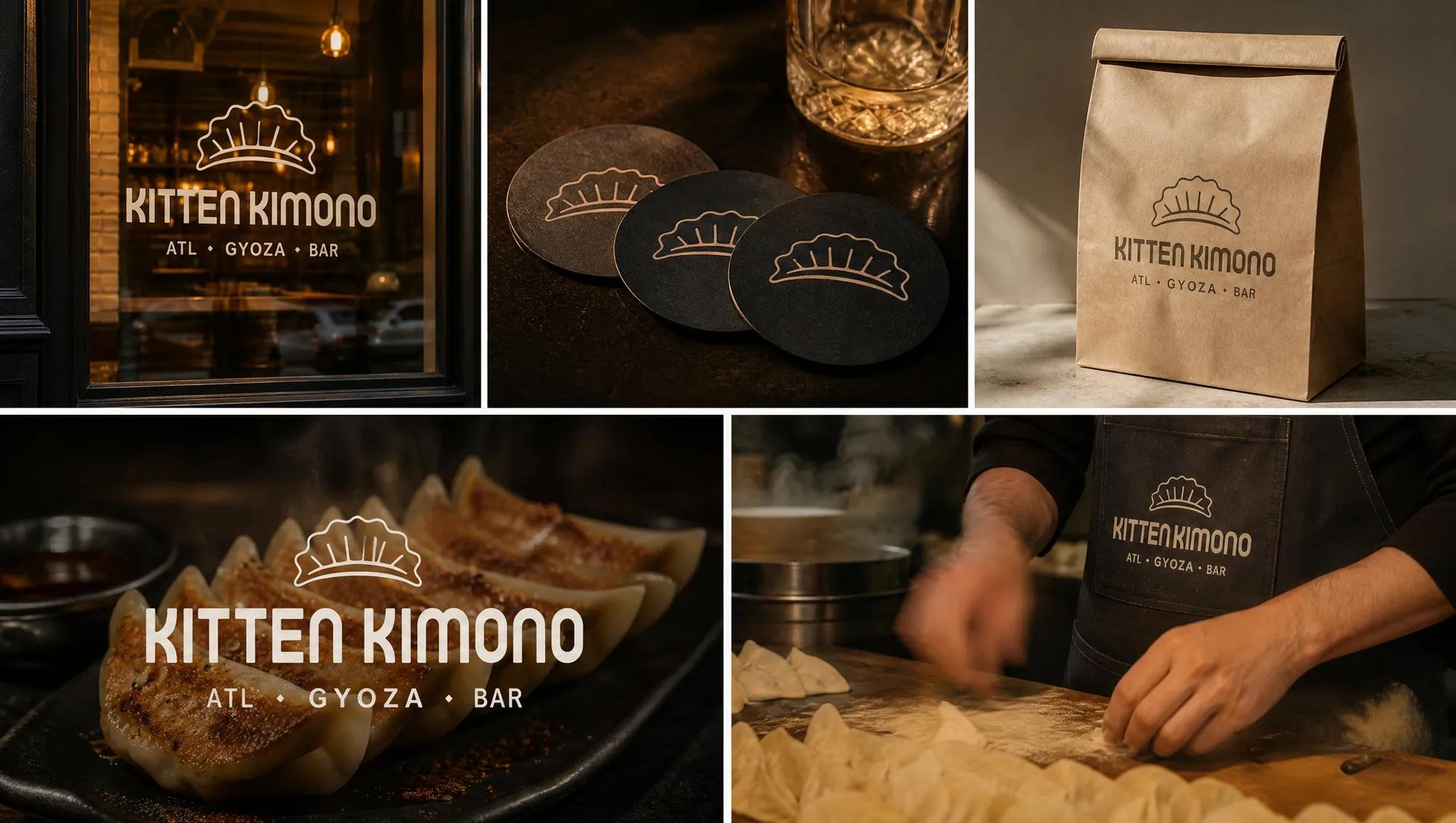
Kitten Kimono, a gyoza-forward bar in Atlanta, arrived without a defined color palette. They had a feeling: dark and moody, hip-hop energy, elevated food, something handmade and a little dangerous around the edges. Walking the restaurant before the shoot, that feeling resolved into something specific. Warm ambers, dark wood, the brown of gyoza skin before it hits the pan. We built the shoot in that direction from the start: capturing the folding and the steam and the raw process, then the product on the plate, then every surface the logo would live on. The window decal, the coasters, the takeout bag, the apron. Same palette. Same mark. Same warmth carried through every touchpoint. The hero image at the top of this article shows the result.
Voice System (What People Read and Hear)
Voice is the visual system's twin, and it is usually the more neglected of the two.
The cleanest way to structure it: separate voice from tone.
Voice: the stable set of three to five traits that don't change across context or channel. A neighborhood burger spot is unpretentious and playful. An elevated gyoza bar is warm, direct, and a little dangerous. Neither of those shifts by what the moment calls for.
Tone: how those traits flex by situation. A celebratory caption reads different from an apology for a long wait, even for the same brand. Mailchimp's public voice and tone documentation is the reference model here: the voice stays fixed while the tone adapts to whether the moment is a win, an error, or a legal notice.
Terminology: the controlled vocabulary that keeps "guests" from becoming "customers" from becoming "users" as copy passes across teams and channels.
Underneath all of it sits the boring glossary work: the actual written list of what to say and what not to say, so that the menu copy, the website language, the social captions, and the script the host uses at the door all sound like the same brand. When they do not, guests feel the seam even if they cannot name it.
Governance (What Keeps It Together)
Governance is the unglamorous layer that decides whether the other two survive contact with a real organization. It answers three questions: who approves, what is non-negotiable, and what is allowed to adapt.
The modern stance comes from the GOV.UK Design System, which built hundreds of services across many teams on a single principle: "be consistent, not uniform" (GOV.UK, 2024). That is a governance philosophy in five words. Keep the distinctive assets and voice pillars fixed. Let local teams adapt within documented rules. The design systems author Nathan Curtis has made the related point for years: federated, community-driven models only work when a central team is genuinely accountable for the core. Distributed creation without a funded center does not produce freedom. It produces drift.
The modern stance is to decide in advance what is fixed and what is allowed to adapt.
| Fix (protect these) | Adapt (let these move) |
|---|---|
| Logo mark, color palette, primary typeface | Layout grids, channel-specific crops |
| Photography mood and quality standard | Subject matter, seasonal references |
| Voice pillars (3 to 5 stable traits) | Tone (shifts by context and moment) |
| Brand terminology glossary | Caption length, format cadence |
| Review gates and approval steps | Template variations by market or location |
The newest governance challenge is volume. As content creation accelerates, the unit of governance shifts. You stop approving individual assets one at a time and start approving the systems, templates, and review gates that produce them.
Where Brand Identity Breaks (And How to Spot It)
When an identity fails, it almost always fails in one of three ways. Naming them makes your own gaps easier to see.
Recognition friction. The brand looks different in every channel, and no distinctive asset carries through. Kia's redesign is the cautionary case: the mark was so stylized that drivers misread it as "KN," which produced a measurable spike in people searching for the "KN car." Distinctiveness only helps if recognition is fast. Test marks in real conditions, at distance and in motion, not just on a clean slide.
Rollout incoherence. A rebrand is half deployed. Some touchpoints are new, some are still old, and the inconsistency itself becomes the story. The Twitter to X transition is the textbook version: a fast symbol and name change with no staged migration plan across handles, signage, and product strings, so confusion replaced equity.
Governance mismatch. Too many people are creating content with no shared rules or templates. Coca-Cola's AI co-creation experiments showed both sides of this: powerful reach when the system held, public criticism when output quality drifted without strong review gates.
Here is the diagnostic question to sit with. If someone only ever saw your brand in one channel, would they learn the same brand story as someone who only saw it in another? If the answer is no, the break is already there.
Start at the Source: Why Photography Is the Foundation
Trace most brand consistency problems back far enough and you reach the same root: source assets that were never planned for reuse.
This is the part of the conversation that generic branding advice never reaches. You can write a flawless guideline document and still end up with a fragmented brand, because the guideline cannot manufacture images that were never shot. If the photography does not exist in the formats, crops, and moods the brand actually needs, every team downstream is forced to improvise, and improvisation is where consistency dies.
The fix is to plan at the shoot level, not the campaign level. In practice that means thinking in three buckets before the camera comes out. Hero frames that anchor the brand. Supporting angles that give layout flexibility. Extension assets, including negative space and alternate formats, that let one scene travel across surfaces. Plan those deliberately and one well-run shoot becomes the raw material for the website, the menus, social, paid, packaging, and in-venue screens. Skip the planning and each of those becomes its own emergency.
A brief for Mess Hall Burgers started exactly that way: a generic request to capture menu images for the website. Before a shot list existed, I asked three questions. Where specifically are these images going to live? What does each placement need to say? Who is the audience?
That conversation expanded the brief considerably. A younger crowd came into focus: casual, not precious, the kind of people who are not afraid of a meal that makes a mess. That single audience clarification changed how we approached plating, styling, and the energy in every frame. We planned for five destinations at once: physical menu, website hero, social banners, and a paid bus ad running near the location. Every setup was framed for hero-level use, because we decided before the shoot that every frame had to travel.
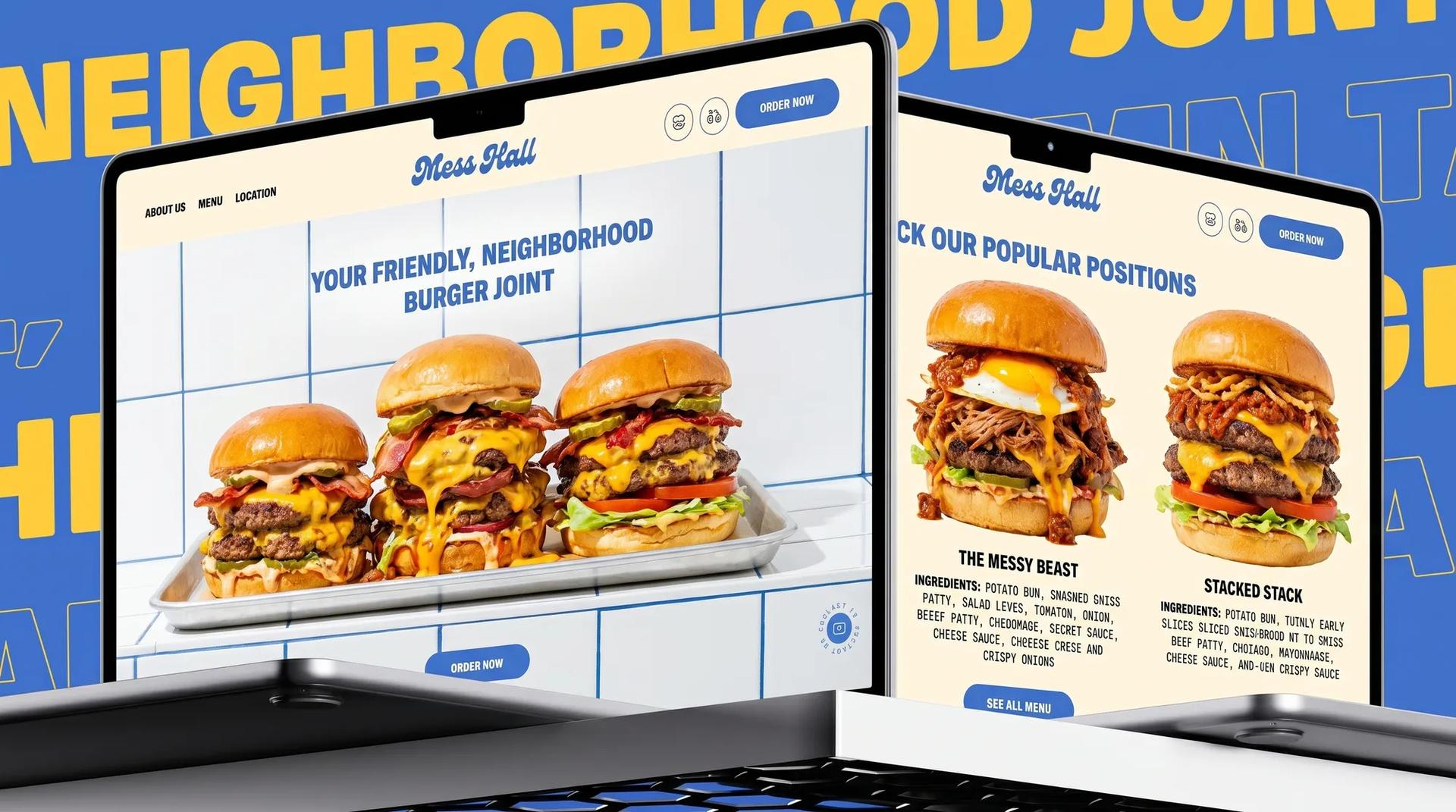
Every image landed. Not because of luck, but because where everything was going was decided before the camera came out.
Craft first. Tools second. One shoot should not equal one campaign. When the source is built as creative infrastructure, consistency stops being a thing you enforce and starts being a thing you inherit. (See Visual Production and how it works.)
Multiplying Consistency Without Multiplying Shoots
Modern brands need more than a good shoot. They need more formats, more variations, more channels, and more velocity than any single production can cover on its own.
The common mistake is to treat each of those needs as a brand new production. More formats means another shoot. A seasonal variation means another shoot. A new channel means another shoot. That math does not scale, and it is the fastest route back to fragmentation, because every separate production drifts a little further from the last.
The alternative is to build source assets that are designed to be extended, reformatted, and multiplied without losing their through-line. This is where hybrid production earns its place: the original shoot stays the anchor, and the system around it handles the variations that used to require starting over.
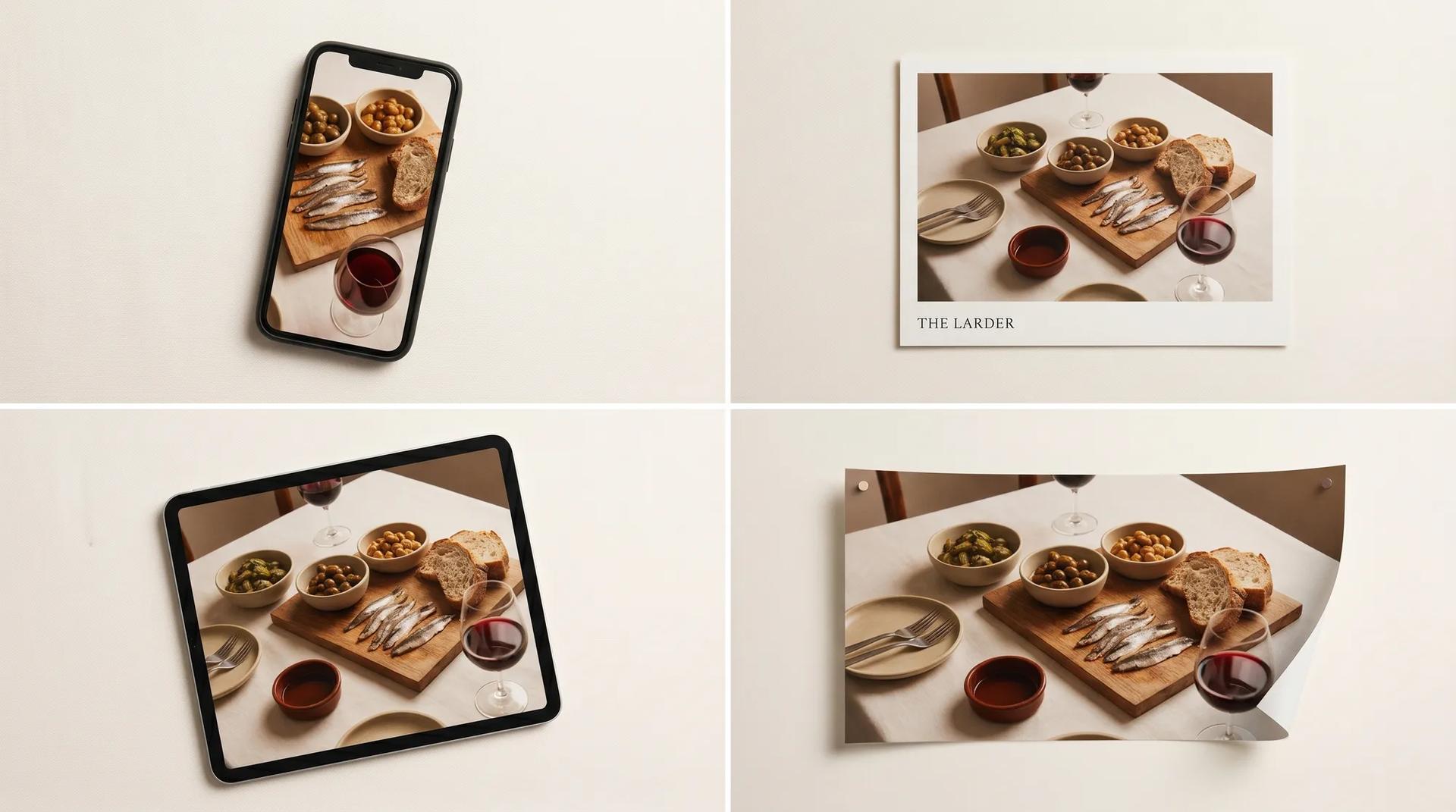
One well-planned hero image deployed across phone, tablet, editorial print, and large-format presentation, without a reshoot, without starting over, without the brand drifting a little further from itself each time. That is what the system is supposed to do. (See Hybrid Production and the AI Studio.)
That capability raises the governance stakes rather than lowering them. When output volume goes up, the unit of governance has to move up with it. You are no longer approving one image. You are approving the templates, the prompts, and the review gates that decide whether a hundred variations stay on brand. The World Federation of Advertisers found in 2024 that fewer than half of multinational brand owners had formal generative AI marketing policies in place (WFA, 2024). The brands that will hold their identity through the next few years are the ones closing that gap now, treating the system as the thing to govern instead of chasing every asset by hand.
The Brand Consistency Audit (Practical Checklist)
You do not need a new platform to find your gaps. You need a quarterly habit. Run this audit in one to two weeks.
- Sample broadly. Pull 30 to 100 real artifacts from across every channel: website, social, email, menus, in-venue signage, packaging, sales collateral. Use what is actually live, not what is in the brand deck.
- Score the visuals. Check logo use, spacing, color, typography, and imagery style against the standard. Small deviations compound, so count them honestly.
- Score the voice. Check reading level, tone alignment, banned phrases, and terminology. Confirm the voice stays stable while the tone adapts to context rather than wandering.
- Check distinctive assets. Count whether your key assets, the colors, type, imagery style, and signature phrases, actually appear in each sample. Assets only build memory if they show up.
- Tag the root cause. For every deviation, name why: unclear rules, missing templates, tools friction, or a governance bottleneck. The pattern in the tags tells you what to fix.
- Build a fix backlog with owners. Convert findings into a backlog, one owner per fix. An audit with no owners is just a complaint.
Track three numbers over time: brand compliance rate (the share of artifacts that pass), off-brand incident rate per month, and template adoption rate (the share of new assets built from canonical templates). When those move in the right direction, consistency is becoming the default.
Frequently Asked Questions
How do I maintain brand consistency across multiple locations?
Start with a shared source asset library and a clear governance model. Define what is non-negotiable, usually logo, colors, photography style, and voice pillars, and define what adapts by location, such as local imagery subjects, cultural references, and seasonal menus. The goal is a central system local teams execute within, not a PDF no one opens.
Does brand consistency mean every touchpoint looks the same?
No. The modern approach is "consistent, not uniform." Your distinctive assets stay stable while creative executions adapt to channel format, audience context, and local relevance. Consistency means the same meaning comes through, not the same layout.
How does AI affect brand consistency?
AI increases the volume of content creation, which makes governance more important, not less. Instead of approving individual assets, you govern templates, prompts, and review gates. Brands that treat AI as a system rather than a shortcut hold their consistency. Brands that treat it as a volume button lose it.
What is the ROI of investing in brand consistency?
Research links consistent brand presentation to revenue uplift in the 10 to 33 percent range, and the IPA found that creative consistency correlates with stronger brand and business effects. For hospitality specifically, a consistent identity across locations and channels reduces guest confusion and builds the trust that drives repeat visits.
Consistency Is an Operating Decision, Not a Project
A unified identity is not something you finish. It is something you operate.
It starts with source assets that are planned for reuse, governed for coherence, and measured for impact. Decide what must repeat, what is allowed to adapt, and what gets treated like infrastructure. Then run the audit often enough that drift never gets a head start.
If your brand visuals feel fragmented, the fastest way forward is rarely another guideline document. It is a production audit that starts at the source. Start a project inquiry and we can look at where your assets are breaking and what it would take to make consistency the default.